Showing posts with label Chemistry Related Career. Show all posts

2013-03-30

DNA Molecules

DNA stands for deoxyribonucleic acid.  It is an important molecules that carry genetic information for living organisms. The molecule forms double helix structure. 

Picture Source : Wikipedia

DNA is a polymer that made up of the smaller repeating units, called nucleotides. 

Some fun facts about DNA(from 10 Interesting DNA Facts

Fun, Useful, and Interesting Facts about DNA, By , About.com Guidez)

  1. If you put all the DNA molecules in your body end to end, the DNA would reach from the Earth to the Sun and back over 600 times (100 trillion times six feet divided by 92 million miles).
  2. A parent and child share 99.5% of the same DNA.


Knowledge about DNA  is widely used in the following fields : 
  1. DNA profiling
  2. Genetic engineering
  3. History and anthopology
  4. Bioinformatics
  5. DNA nanotechnology. 

2013-03-26

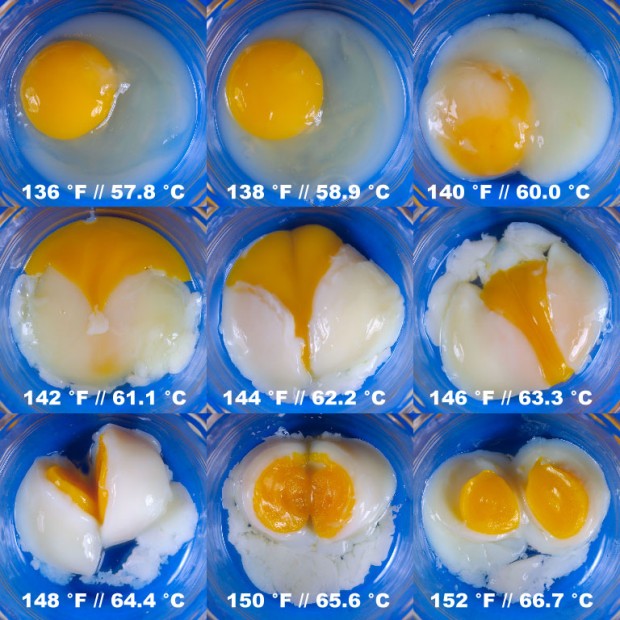
How does temperature affect eggs?


Do you like eggs? Half-boiled, fried egg, etc....
Have you ever pondered these questions?
  1. Do different temperature affect the texture of eggs?
  2. Does the size of eggs affect the cooking of eggs?
I thought cooking eggs just a simple thing for every lay man like me.  I was surprised to find that a branch of food science, called Molecular Gastronomy investigate all these. 


Source : DouglasBaldwin.com

The picture shown eggs cooked in a water bath for 75 minutes at temperature from (57.8 0C to 66.7 0C) by Douglas Baldwin.

In Khymos's blog, Towards the perfect soft boiled egg, I even found a formula relating temperature of water,  mass of eggs & cooking time.

Amazing?

According Wikipedia, Molecular Gastronomy is a sub-discipline of food science that seeks to investigate, explain and make practical use of the physical and chemical transformations of ingredients that occur while cooking, as well as the social, artistic and technical components of culinary and gastronomic phenomena in general.

2009-12-02

Chemistry Related Career

   One day, one of my students came to approach me after the end of her chemistry lesson.
    "Teacher, is it good I further study in chemistry?" She asked.

   "Of course, yes! But which part of chemistry do you like the most?" I said.

   She started to fall into a deep thought.

   Actually, deep in my heart, I'm glad my students have interest and plan to study more about chemistry.

  There are many fields requires chemistry knowledge:

  1. food science
  2. forensic science
  3. environmental science
  4. oceanology
  5. geochemistry
  6. education(teacher, or lecturer)
  7. biotechnology
  8. medicine
  9. engineering
  10. plastic chemistry
  11. metallurgy
  12. agrochemistry
  13. pharmaceuticals
  14. dietian

  The list is incomplete. Chemistry works in any industrial, educational, scientific, or governmental field. A chemistry student is equipped with excellent analytical and mathematical skills which help them to solve problems in their job.


  Perhaps I'll post more chemistry related career later. So, what's your choice?

 For further reading, you might visit American Chemical Society.