Showing posts with label Rate of Reaction. Show all posts

2013-03-26

How does temperature affect eggs?


Do you like eggs? Half-boiled, fried egg, etc....
Have you ever pondered these questions?
  1. Do different temperature affect the texture of eggs?
  2. Does the size of eggs affect the cooking of eggs?
I thought cooking eggs just a simple thing for every lay man like me.  I was surprised to find that a branch of food science, called Molecular Gastronomy investigate all these. 
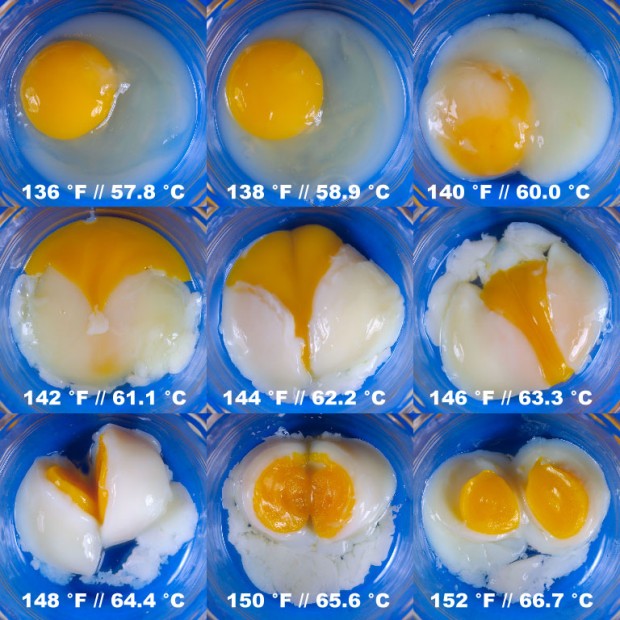


Source : DouglasBaldwin.com

The picture shown eggs cooked in a water bath for 75 minutes at temperature from (57.8 0C to 66.7 0C) by Douglas Baldwin.

In Khymos's blog, Towards the perfect soft boiled egg, I even found a formula relating temperature of water,  mass of eggs & cooking time.

Amazing?

According Wikipedia, Molecular Gastronomy is a sub-discipline of food science that seeks to investigate, explain and make practical use of the physical and chemical transformations of ingredients that occur while cooking, as well as the social, artistic and technical components of culinary and gastronomic phenomena in general.

2013-01-24

Interpreting Graph relating to Rate of Reaction


Hydrogen peroxide decomposes to water and oxygen.


In this reaction, rate of reaction is measured by the changes in volume of oxygen gas released per unit time.

Rate of reaction can be shown by a steeper curve.

Curve Q has  a steeper curve.  The rate of reaction is higher.   The possible factors affecting the rate of reaction is : size, concentration, temperature, pressure and catalyst.  The possible factor mostly is concentration.  Higher concentration, higher rate of reaction.  

Curve Q shows that volume of gas released is lesser. 

Volume of oxygen gas released depends at the quantity of reactant(in more specific, number of moles of hydrogen peroxide used).   

Number of moles of hydrogen peroxide used in the initial experiment is 

(0.1 x 25)/1000 = 0.0025 

After determining number of moles of hydrogen peroxide given in A, B, C & D. 

Only the number of moles of hydrogen peroxide in C is the smaller than 0.0025.

The correct answer : C


Determining Rate of Reaction


In the reaction between limestone powder(calcium carbonate) hydrochloric acid, 17 cm3 of carbon dioxide that produced is in 3.5 minutes. 
Average rate of reaction is 17 cm3/3.5 min

But, during the second minute, only (12.5 - 7.5) cm3 of carbon dioxide gas released in 1 minute time, 

Average rate of reaction during the second minute is

(12.5 - 7.5) cm3 / (2 - 1) min 

The correct answer is : C

2013-01-09

Slow Reaction

Slow reaction has low rate of reaction. It takes a long time for the reaction to be complete.
Examples of slow reaction :


Rusting of Iron
An iron takes a long time to react with oxygen and water to form rust(brown solid on the iron nail), which is known as hydrated iron(III) oxide, Fe2O3.3H2O.


*credit to Wikipedia


Formation of stalagmites
Stalagmites are formed due to the dripping of mineralized solutions and the deposition of calcium carbonate. Normally this stalagmites formation only occurs under certain pH conditions within the underground cavern.


Ripening of fruits


2012-02-12

Individual Assignment - Rate of Reaction


  1. Compare the rate of reaction in Set I and Set II.                 [2 marks]
  2. Explain your answer with reference to the collision theory.  [4 marks]


    Individual Task 
    1. Please click at the comments below this post. A text box will appear.
    2. Write in the text box the answer for the question posted above.  No plagiarism!
    3. Remember to include your name before you click the button Publish. 
    4. The greatest comment posted will be given an token after we meet again in class!
    5. Due date : 6 pm, 17 March 2012.

2012-02-04

Individual Assignment 5G - Rate of Reaction

We just finished Chapter 1 Rate of Reaction on 3/2/2012. The holiday task is given to you so that you are more familiar with the questions in the real SPM.  Any problems, please leave your questions here/chatbox. The rest of the 5 Gastisian are welcomed to answer your friends' question too.

 
Individual Task
  1. Please click at the comments below this post. A text box will appear.
  2. Write in the text box the important concept that you wont forget in your daily life from Chapter 1 Rate of Reaction.  The minimum length is 2 sentences. No plagiarism!
  3. Remember to include your name before you click the button Publish. 
  4. The greatest comment posted will be given an token after we meet again in class!
  5. Due date : 6 pm, 7 Feb 2012.


2012-01-30

How Does Pressure Increase the Rate of Cooking?


 The high temperature in pressure cooker increases the boiling point of  water to a temperature above 100 0C.  The food absorbs more heat.  Hence, the time taken for the food to be cooked becomes shorter.  Thus the food is cooked  faster at a higher temperature in a pressure cooker.

2012-01-18

Measurement of Rate of Reaction between an acid with Marble Chips


How to measure rate of reaction between an acid with marble chips?

First, we need to figure out the observable changes in quantity of reactant/product.

The observation mostly given by my class students are as follows :
  1. marble chips dissapears.
  2. gas bubbles produced.
Which quantity they would like to measure? Ha ha.. many students were stucked and were unable to given any response. Some might gave nonsence. The hand glove was purposely fixed on the mouth of a beaker filled with acid and marble chips. Soon, they realised it wasn't an accurate way of measurement the quantity of gas.   Slowly the students were guided to use the water displacement method to measure the changes in volume of gas released per unit time.

2011-05-09

Numerical Problems Involving the Factors that Affect the Rate of Reaction

Numerical Problems Involving the Factors That Affects the Rate of Reaction

2011-02-12

Question 3 Paper 3 Chemistry SPM 2010


Actually, the question is quite direct. There are many possible experiment plan. In fact, in student's textbook, students were asked to plan an experiment to study whether copper (II) sulphate affect the rate of reaction between zinc and sulphuric acid too.

Some useful guides when attempting this question:
  1. Give an example of acid & metal.
  2. How does metal react with acid? What is produced?
  3. How to do measure rate of reaction in an experiment? Hint: Rate of reaction is measured based on observable changes of quantity of reactant/product over a period of time. 
  4. What are the required information/data to compare the effect of catalyst on the rate of reaction?
  5. Try to imagine the materials & apparatus required.
  6. Draw diagram to show the set-up of apparatus for the experiment.
  7. Think of the steps to set-up the apparatus till recording data required.
  8. Write down your plan.
  9. Recheck your plan. Especially for materials, apparatus & procedure & tabulation of data. Students do forget some important point.
Similar question was appeared in SPM 2005, click here. The candidates are asked to plan an experiment to study the effect of concentration on the rate of reaction between a named metal & a named acid. My students get confused when they looked at the question. The first idea popped out from the head was reaction between sodium thiosulphate & sulphuric acid which in fact a wrong plan.

2011-01-28

Effect of Concentration of Sodium Thiosulphate on its Rate of Reaction with Sulphuric Acid

5C students carried out their investigation to study the effect of concentration of sodium thiosulphate on its rate of reaction with sulphuric acid on 24 Jan 2011.

Before the experiment, they were ready with their experiment plan. Most of them were able to write a satisfactory experiment plan. However, the aim of the experiment, problem statement were not specific.  Some even were not ready with their table. Hopefully they would improve after discussing with me.

The students were able to carry out the experiment with correct technique & skills. Well done, 5C students!
The student was taking time for mark 'X' dissapear from view.
 
Cooperation is shown througout the experiment.

The conical flask is swirled once sulphuric acid is added into sodium thiosulphate.

Mark 'X' is observed from top of the conical flask. The other pair of students were discussing their data.

2010-08-11

How Factors Affecting the Rate of Reaction are Applied in Industrial Processes


Questions about the topic is frequently found in Paper 1 SPM. Students are given various choices of condition of reaction but students hardly to pick a correct answer. Normally when I teach rate of reaction, I ask my students to collect all related information and complete the table. They can revise it anytimes  especially last-minute revision.

Sometimes, this topic is asked in Paper 2 too. Students are asked to state the temperature, pressure & catalyst in a reaction and explain how does each factor affecting the rate of reaction by using collision theory.

2010-05-27

Students' Definition of Rate of Reaction

 
In one of the question in the recent examination, one question asked about the meaning of the rate of reaction. I compiled the answers from one of my class. The following are their answers:  

  1. Change amount of reactant or product against time
  2. Change in the amount of reactants against product formed
  3. Change of selective quantity of product or reactant against time
  4. How fast the reaction occur at particular time
  5. How fast reaction takes place in a reaction
  6. Measurement of the amount of change of reactant or products against time taken
  7. Rate of formation of product over time
  8. Rate of substance to react with solution
  9. Speed of a chemical reaction
  10. Speed of reaction of a substance in one second
  11. Amount of reactant that has been used up or the product that is formed in a unit of time
  12. The amount of product produced in a reaction to time
  13. The amount of products formed in a reaction per time
  14. The amount of reactant over a time
  15. The amount of reactant used up or the amount of product obtained per unit time
  16. The measurement of the change in amount of reactant or product against time
  17. The rate of change of reactant or product over time
  18. The rate of time that a substance is able to react completely with another substance
  19. The time taken for a reactant to react completely
  20. The time taken for the reaction occur
  21. Time for reactant to react to produce product
  22. Time or the speed of reaction to take place
  23. Time taken for the amount of reactant react to produce an amount of product
  24. Time taken for the reactant to be reacted
  25. Time taken needed for the volume to undergo chemical changes

 
NONE of them gave the same answers. Each of them has different understanding of the definition of Rate of Reaction.  But most of them have misunderstood the term! Only answer 3 give an accurate definition.  What a pity! Perhaps some of them did try to memorize during revision, but memorizing without understanding is not effective at all.
Let's have a look, what can I do to clarify this when I enter their class later.

2010-03-12

Paper 3 SPM 2005 - Planning an Experiment


In paper 3 Chemistry SPM, a student is asked to plan an experiment based on the situation given. I have given this question to my students as an exercise. Most of the time, they would give me an wrong experiment plan. They planned experiment exactly the same as the experiment they carried out to investigate how the concentration of sodium thiosulphate affect its rate of reaction with sulphuric acid. 

Samples of answer please click here.

2010-01-09

A Perfect Graph


In the beginning of Chapter 1, Rate of Reaction in Form 5 Chemistry, a students needs to draw a graph to show the changes of quantity of reactants/products over a period time.

A perfect graph must have few criteria as follows:


  1. Title
  2. Label the two axes with the correct unit
  3. Choose a suitable scale. The size of the graph should be at least ¾ of the size of the graph paper.
  4. Plot all the points correctly
  5. Smooth graph (curve or straight line )

   Most of the time, I found my students a bit hard to draw a perfect graph especially when drawing a smooth graph.  Perhaps they need a sharp pencil and more practice.  The skill again will be assessed in PEKA through the coming experiments to investigate the effect of temperate and concentration of reactants on the rate of reaction. All the best and good luck!!

2009-12-23

Rate of Reaction between Zinc and Hydrochloric Acid


This video shows the reaction between zinc and hydrochloric acid.  Hydrogen gas is released in both conic flasks.

Points to ponder:
  1. Any possible reasons that contribute the different size of ballons in both experiments?
  2. How to measure the of rate of reaction?

2009-08-28

Paper 3 Trial SBP Year 2009

I'm marking paper 3 of my students now.  So far, students seems not to have much problems in this paper. Average of 5C students score 38/50.  Hopefully the rest of the students would perform too.

Will write more what I notice in the students' answers once I finish marking all the papers. 

This paper touch on
  1. Electrochemical series
  2. Effect of temperature on the rate of reaction
I suggest all form 4 students to try to answer the first question(Electrochemical Series) of this paper before you sit for your finals exam.  It'll help you to have a better idea about the format of the question from Paper 3. To view the question, please click.