Showing posts with label Electrochemistry. Show all posts

2013-11-21

Electrolysis of Copper(II) Sulphate


Be analytic when study electrolysis of an aqueous solution.

3 factors affecting product of electrolysis  of an aqueous solution.
  1. type of electrode
  2. concentration of ion in aqueous solution
  3. position of ion in the Electrochemical Series.
What factors are affecting product at anode & cathode during electrolysis of copper(II) sulphate solution?

Position of ion in the Electrochemical series

How do concentration & type of electrode affect product of electrolysis?


2013-07-15

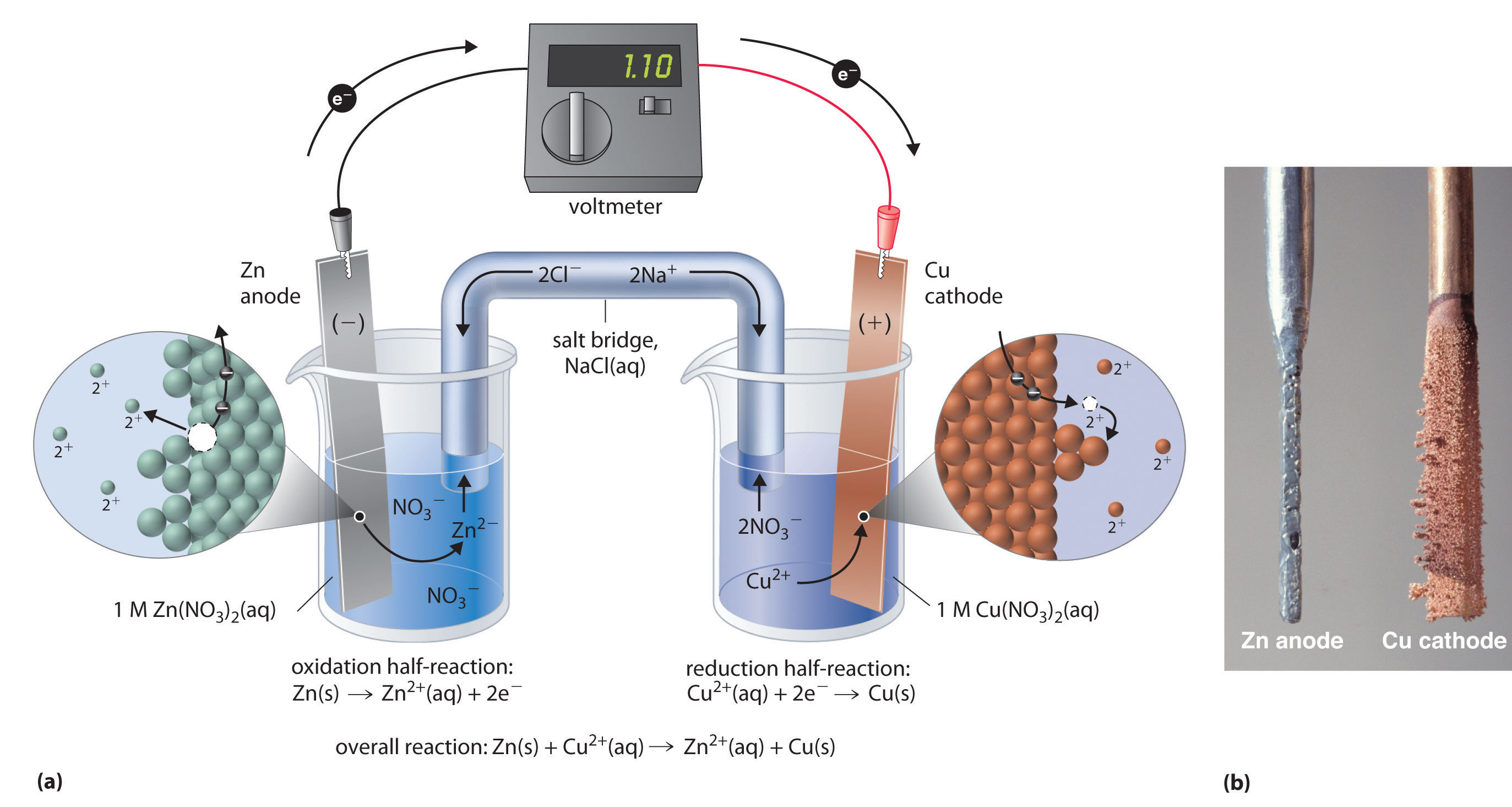
Daniell Cell


An animation from you tube explaining how the reaction occurs in a Daniell Cell

2013-07-07

Electrolysis of Molten Lead(II) Bromide

Set-up of apparatus to study electrolysis of molten lead(II) bromide

Diagram shows reactions occurs during electrolysis of molten lead(II) bromide at both electrodes
  • Molten lead(II) bromide consists of lead(II) ions and bromide ions.
  • During electrolysis of molten lead(II) bromide, bromide ions move to anode and lead(II) ions move to cathode.
  • At anode, bromide ions are discharged by releasing electrons to form bromine. Half equation for the reaction is 2Br-  --> Br2 + 2e-
  • At cathode, lead(II) ions are discharged by accepting electrons to form lead.  Half equation for the reaction is 
           Pb2+ + 2e- --> Pb

2012-08-16

Olympics 2012 Medals : From Mine to Medals


The precious ore for the Olympics medals has been supplied by London 2012 sponsor Rio Tinto and was mined at Kennecott Utah Copper Mine near Salt Lake City in America, as well as from the Oyu Tolgoi project in Mongolia. 

The Rio Tinto official webpage provides  an interactive explanation on every process involved from Mine to Medals. 

Some processes involve Chemical Reactions :  

  • Extraction
  • Smelting
  • Refining(Purification)

2011-08-12

Different type of Voltaic Cells


Please find more details about the chemicals used for negative terminal, positive terminal & electrolyte and its advantages/disadvantages.

2011-08-11

Simple Voltaic Cell


Explain the production of electricity in the simple voltaic cell.

  1. Magnesium is more electropositive than copper.  Magnesium is the negative terminal.
  2. Each magnesium atom donates two electrons to form a magnesium ion.  Mg --> Mg2+ + 2e-
  3. The flow of electrons from the magnesium ribbon to the copper through the external circuit results in the production of electricity.
  4. The hydrogen ions from the electrolyte(sodium chloride solution) are discharged at the copper plate by accepting electrons to form hydrogen gas.  2H+  + 2e- --> H2
What is the observation at each of the terminal? 

Please respond by leaving your answer in the comment box.

2011-04-24

Electrolysis of Copper(II) Chloride


The usage of cartoon in explaining the concept of electrolysis copper(II) chloride solution. Another alternative for students to understanding an abstract concept in chemistry.

2010-08-13

SPM 2007 Paper 3 Question 2 - Chemical Cells

Please attempt the question first. If you have any querry, don't hesitate to email me. 
Q2

Suggested answer, please click here.

2010-07-14

Elelctrolytic Cell and Chemical Cells

In an electrolytic cell,
  • Anion in the electrolyte move to  anode(connected to the positve terminal of the battery).
  • Anions is selectively discharged by losing electrons(Depends at the concentration of ions in the electrolyte). In other words, anion is oxidized at anode. If metal electrodes are used instead of carbon electrodes, metal is oxidized to its metal ions by losing electrons.
  • Cations in the electrolyte move to cathode(connected to the negative terminal of the battery).
  • Cations which is at the lower postion in the Electrochemical Series is selectively discharged by gaining electrons. In other words, cations are reduced.

oxidation occurs at anode while
Reduction occurs at cathode.


In a chemical cell
  •  Electrode which is more electropositive is oxidized to its ions by loses electrons, and acts as negative terminal.
  • Electrons move through the external circuit and received by positive terminal.
  • Cations in the electrolytes get attracted to the positive terminal and reduced to metal by gaining electrons.
Oxidation occurs at negative terminal.
Reduction occurs at positive terminal.

2009-12-25

Predict the Product of Electrolysis of Aqueous Solution

Most students are having a big problem in electrochemistry.  Normally questions related to electrolysis of aqueous solution are their common mistakes.

This is one of the questions in Chemistry SPM 2009 Paper 2.

If you need guide to predict the product of electrolysis of aqueous solution, click here.

You're welcomed to email your answer to sweemoi@gmail.com.  I'll reply and give comments as soon as possible.

2009-08-28

Paper 3 Trial SBP Year 2009

I'm marking paper 3 of my students now.  So far, students seems not to have much problems in this paper. Average of 5C students score 38/50.  Hopefully the rest of the students would perform too.

Will write more what I notice in the students' answers once I finish marking all the papers. 

This paper touch on
  1. Electrochemical series
  2. Effect of temperature on the rate of reaction
I suggest all form 4 students to try to answer the first question(Electrochemical Series) of this paper before you sit for your finals exam.  It'll help you to have a better idea about the format of the question from Paper 3. To view the question, please click.

2009-08-07

Electroplating A Coin with Copper

Yesterday when I entered my chemistry class, I challenged my students to electroplate their key chains/coins with copper before leaving chemistry laboratory at the end of my lessons.

Throughout the lessons, everybody paid 100% attention. By the time they started working in groups, they started talking profesionally.

"use the coin as cathode"

"copper is connected to the positive terminal"

"Wow, teacher, come and have a look! Changes occur so fast!"

"TEAcheer, how does it happen?"

"The coin is so nice!!!!"
This is the product prepared by Diyana. She said she wants to show it to his dad.
I really enjoyed the lesson especially looking them leaving the lab with happy smiling face! Hope everyone realise the importance of electrolysis in their daily life!
Chemical equation that shows the reaction occurs
at anode : Cu ---> Cu2+ + 2e-
at cathode : Cu2+ + 2e- --> Cu

2009-08-05

The First Battery


Types of battery available:
  1. dry cell
  2. alkaline cell
  3. mercury cell(e.g. battery in watch, calculator)
  4. lead acid accumulator(e.g. car battery)
  5. nickel-cadmium cell(e.g. rechargable battery mostly used in camera)
  6. lithium ion cell(e.g. laptop, iPod)

2009-06-09

Displacement Reaction

I found these two videos on displacement reaction from youtube.com. It's quite interesting! Have a look...


(1) Reaction between silver nitrate solution and copper


(2) Reaction between copper sulphate solution and iron nail
For the first reaction, reaction between silver nitrate solution and copper
  • copper is more electropositive than silver
  • copper displace silver from its salt solution
  • the silver solid, silver is displaced by copper from its salt solution
  • Chemical equation:
     AgNO3(aq) + Cu(s) --> Ag(s) + Cu(NO)3(aq)
Question: Why does the colourless solution turns blue?
For the second reaction, reaction between copper sulphate solution and iron nail
  • iron is more electropositive than copper
  • iron displace copper from its salt solution
  • the brown solid, copper is displaced by iron from its salt solution
  • Chemical equation: 
      CuSO4(aq) + Fe(s) --> FeSO4(aq) + Cu(s)
Question: Why the intensity of blue copper sulphate solution decrease?
Points to ponder: Why both reaction are examples of redox reaction?